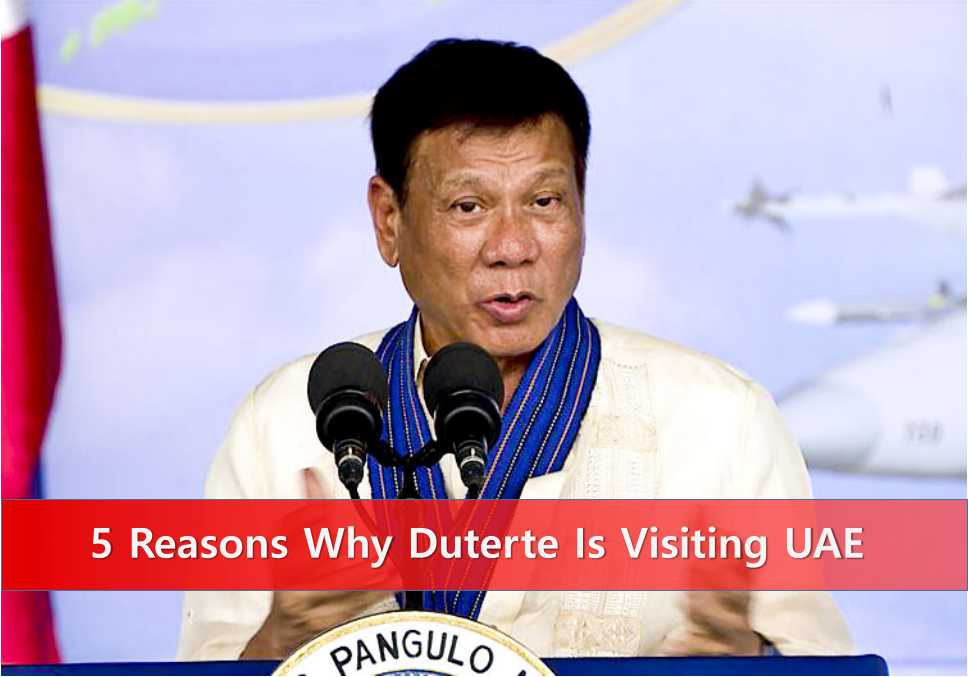
President Rodrigo Duterte will discuss bilateral agreements with UAE leaders, meet the Filipino community and ensure that he delivers on his campaign promises, said Foreign Affairs Secretary Perfecto R. Yasay, Jr.
By Jojo Dass
DUBAI: President Rodrigo R. Duterte will be visiting the UAE with a five-point agenda.
These are to express gratitude to the overseas Filipinos for their support; listen to their concerns; formulate policies address these issues; strengthen bilateral ties with the host country; and sustain growth back home so that working abroad would no longer be a necessity but a choice.
Foreign Affairs Secretary, Atty. Perfecto R. Yasay, Jr. said Duterte’s trip, tentatively scheduled for March, will not be a short one as the president “would like to make sure that he is able to deliver on the promises he has made” while on the campaign trail. Aside from UAE, the President will also visit the Kingdom of Saudi Arabia to meet with Filipinos displaced by the oil and gas slump; and another Gulf country.
The Filipino Times broke the story on the president’s trip several weeks back, stating that arrangements were being made for a Jan. 25-27 itinerary. Yasay confirmed this saying Duterte had initially planned to do it but the schedule was adjusted because of other official commitments, among them the Asean meetings where the Philippines accepted the chairmanship for 2017.
1. Gratitude

Speaking before a jam-packed crowd of about 400 people during a town hall meeting at the Canadian University of Dubai auditorium the evening of Jan. 23, Yasay said Duterte would like to reciprocate the huge vote he garnered from Filipinos in the UAE during the 2016 presidential race.
“He had longed to be here to fulfil a promise, knowing pretty well that a real important reason why he is now president is because of your support and your vote to have him elected as president. So, he asked me to convey to all of you his thanks,” Yasay said.
He added, “The president campaigned on the promises of helping every Filipino, specially our overseas Filipino workers (OFWs). He was very candid about this in the campaign. And Mr. Duterte would like to make sure that he is able to deliver on the promises he has made.”
Duterte got 51,879 – or 83.5 percent – of the total 62,103 actual votes cast in the UAE during the 2016 May presidential election
2. Bilateral agreements

Yasay said senior Philippine officials “are now engaging our counterparts in these countries for the purpose of entering into agreements to strengthen our bilateral agreements” as a prelude to Duterte’s trip.
Part of these trips is a trade mission The Filipino Times has reported involving the Philippine Economic Zone Authority (PEZA) led by its director general, former Butuan lawmaker Charito Plaza.
The mission, scheduled for Feb. 11 and 12 will meet with some 50 representatives from the UAE business sector.
3. Listening to OFWs

The last time a Philippine head of state visited the UAE was in April 2009, when then President Gloria Macapagal-Arroyo met with UAE President, His Highness Shaikh Khalifa Bin Zayed Al Nahyan to discuss bilateral relations and how to improve them.
Yasay said Duterte’s visit will be different.
“The trip is not something for other reasons. We are coming here to address specific problems. He could not himself fully understand why Filipinos would much rather want to remain here. He would like to make sure that he fully understands this,” he explained at the town hall meeting.
“He will not only go to Saudi or UAE and go back home. No, he will stay here for a few days, talk to the leaders and see what kinds of agreement can be signed,” he added.
Overseas Filipinos, officials said, are usually beset with any of these five problems: indebtedness, intoxication, immorality, illegal recruitment and improper documents.
In the UAE, Ambassador Constancio R. Vingno Jr. has said over 100 OFWs are in jail on drug-related cases. Citing the embassy’s official report to Congress covering the first half of 2016, Vice Consul Anna Guerra said immorality (66) topped the cases involving OFWs in Abu Dhabi for that period followed by indebtedness (40) and illegal drugs (17). She said there also were 30 cases of theft, which she said, is usually filed by employers against runaway employees.
In Dubai, Consul General Paul Raymund Cortes said there were 34 cases of immorality, 24 cases of indebtedness and seven cases of intoxication also for the same period. Data for the second half is still being collated, he said.
Yasay said OFWs should make it a point to abide by the law of the host countries to keep themselves away from legal troubles. In the same vein, Vingno and Cortes have repeatedly urged them to observe statutes, reminding them of the reasons why they are working abroad in the first place.
4.Formulate policies

Yasay said the Duterte Administration’s approach in resolving the OFW problems is two-fold. “One is to make sure that life will be easier for you as you apply for services with Philippine government offices; and, two, making sure that in the near future, you will no longer be going abroad and be forced to look for jobs.”
Among Duterte’s flagship programs for OFWs are the creation of a separate department for OFWs, the creation of an OFW bank and the abolition of the Overseas Employment Certificate (OEC).
Officials said it is anticipated that Middle East-specific policies will be implemented based on the president’s findings.
5. Sustained growth

Sustaining the Philippines’ economic growth by improving trade ties with UAE and making more jobs available back home go hand in hand with the Duterte administration’s platform for OFWs, according to Yasay.
“It is the hope of President Duterte that before his six year term is over, those who apply for jobs abroad will simply be doing so on the basis of choice rather than forced to do so,” he said.
Total trade between the Philippines and United Arab Emirates stood at $834.50 million in 2015. Latest available figures indicate that total trade between the two countries was $567.99 million as of August 2016, according to Commercial Attaché Eric C. Elnar.
Elnar said the Philippines imported $521.23 million worth of goods from and exported $312.12 million worth of goods to UAE in 2015.
With the recent signing of a Memorandum of Understanding between the Philippines and UAE, he said the Duterte administration could negotiate toward a trade agreement that would give “preferential treatment for our products coming to the UAE.”