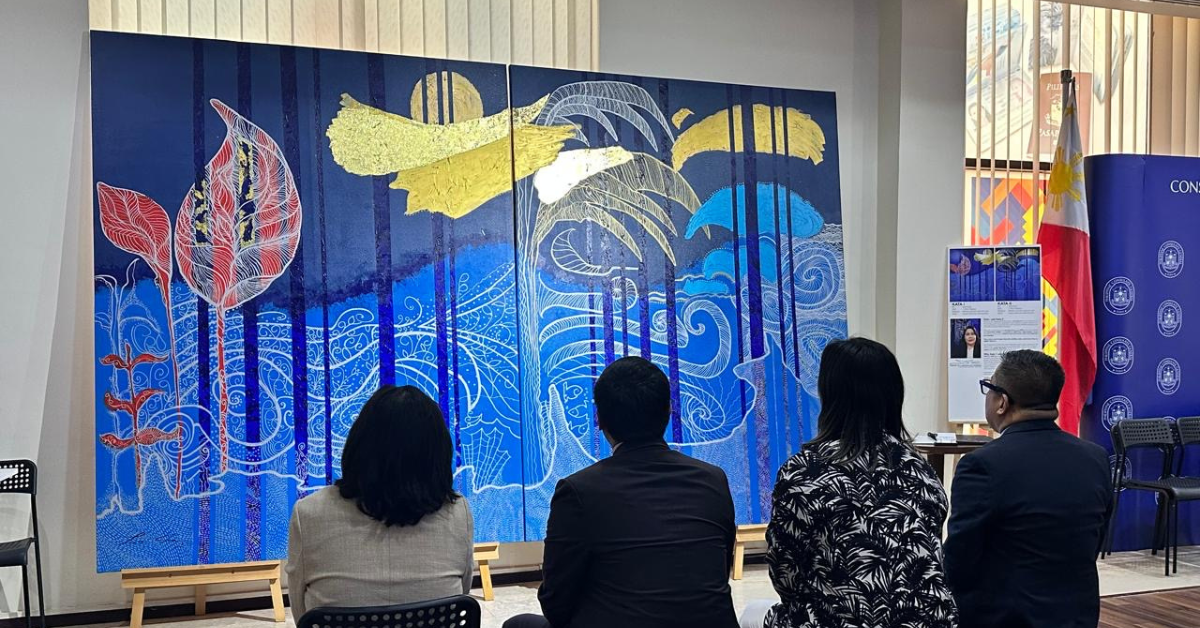
At first glance, they shimmer — two towering canvases bathed in shades of blue, red, silver, and metallic gold. Their textures alive with movement, their lines flowing like sea currents. But look closer, and the story begins to unfold.
These are Kata I and Kata II, large-scale mixed media works by UAE-based Filipino visual artist Susan Villanueva-De Guzman that reflect the strength, connection, and quiet resilience of Filipino migrant workers across distant shores.
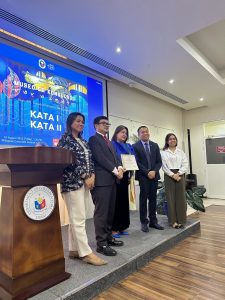
The twin murals were officially unveiled on August 1 as part of the Philippine Consulate’s ongoing cultural diplomacy initiative, Museo sa Konsulado, which highlights Filipino creativity and identity in the diaspora.
Beyond technique or scale, what resonates most is the meaning they carry — a message that speaks directly to Filipinos living and working overseas conveyed through abstraction and symbolism drawn from both nature and memory.
A visual conversation that became we
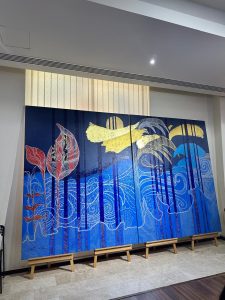
The pieces, each measuring 1.9 by 2.4 meters, are intentionally inseparable and meant to be viewed together, depicting “two halves of a single soul mirroring the journey of a nation and its people.”
It explore two sides of migration: Kata I represents those who are rooted, while Kata II depicts the one in flight.
“But neither stands alone,” De Guzman shared in an interview with The Filipino Times. “Together, they speak of a shared journey — a love for country, and the enduring thread of identity.”
The title Kata comes from an old Tagalog word meaning “you and me” — or more deeply, “we.” Through the twin murals, aimed to reflect the unity and unbreakable spirit of Filipinos in the diaspora.
And like the Philippine corals, often fragile-looking but astonishingly tough, she saw a metaphor for overseas Filipinos: toughened by being scattered, but constantly growing.
“When broken and cast away, it clings, grows, survives, and eventually becomes the foundation of new life. Filipinos abroad are much like these corals, dispersed, yet resilient; displaced, yet constantly building vibrant communities wherever they go,” said De Guzman, who was also hailed the Artist of the Year at The Filipino Times Watchlist Awards 2016.
Having lived among OFWs for years, she has seen the weight of separation, the ache of longing, and the quiet heroism that defines daily life abroad.
“These twin works reflect that reality. Kata […] holds within it the idea of togetherness, and a whisper between two shores,” she said.
Built with time and soul
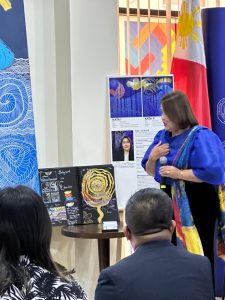
Also previously showcased at the Philippine Pavilion during Expo 2020 in Dubai, the creation of Kata I and Kata II took about two and a half months.
“The works are a blend of abstraction, cultural symbolism, and personal expression, using natural elements like earth, water, air, and fire to symbolise humanity and individuality,” she said.
For the execution, De Guzman used metallic acrylic and foil leaf on canvas, weaving lines as her central design element into a fluid narrative across both pieces.
Honoring OFWs through art
While De Guzman’s previous works often centered on introspection or visual experimentation, Kata I & Kata II are more outward-looking, exploring the collective memory and lived experiences of Filipinos abroad.
“They stretch outward to encompass collective memory, diaspora, and the emotional landscape of being Filipino,” she explained. “The visual language remains fluid and spontaneous, but the intention is now deeper: to document, connect, and elevate the soul of people. In that sense, Kata is both a progression and a homecoming.”
For De Guzman, the murals serve as a tribute, not just to the economic contributions of OFWs, but to the emotional strength behind their sacrifices.
“In works like Kata I and Kata II, I do not simply paint people,” she said. “I honor lives rebuilt on foreign soil, spirits tested by distance, and the quiet poetry of survival.”
She also believes that artists carry the responsibility of honoring migrant stories, not simply observing, but building bridges through their work.
“Through color, texture, and metaphor, we humanize statistics, unpack luggage heavy with longing, and offer a mirror to those searching for belonging,” she added.
A message to fellow artists
To Filipino creatives abroad who want to share their stories through art, De Guzman offered gentle encouragement: Your story matters. She reminded them that they carry not only their craft but also the memory of their people, the strength of their roots, and the beauty of their dreams.
“Never underestimate the power of your brushes, your lens, your lines, your voice. Through art, we reclaim space, assert identity, and breathe life into what distance tries to fade,” she said.
And for those who wonder if their stories are worth telling, she adds: “Tell your truth, even if your voice trembles. Someone out there needs to see it, feel it, and know they’re not alone.”
As she put it: “We may be scattered like islands across oceans, but through art, we remain one archipelago — connected, rooted, and rising.”
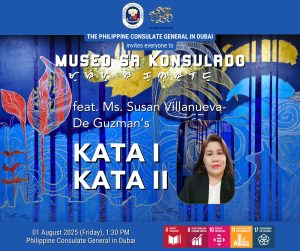
Kata I and Kata II will remain on display at the Rizal Hall of Philippine Consulate in Dubai, until August 29. The exhibit is open to the public from Monday to Friday, 8 AM to 3 PM.
For OFWs longing for a quiet connection to home, it’s worth a visit.