
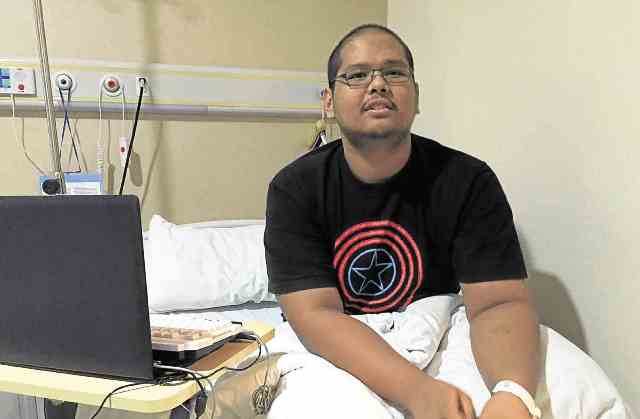
The Philippine Daily Inquirer has recently shared the story of Roque Esteven Bello—a 21-year-old bone cancer patient who was told by Manila-based doctors that he had six months left to live, even after having undergone a leg amputation and chemotherapy sessions.
That was 2013. Today, Belo is still alive and actually getting better. This is after he followed a recommendation from a another cancer-stricken friend and took his chances at Modern Cancer Hospital Guangzhou (MCHG), an 11-year-old medical establishment in the southern Chinese city, that offers what it considers to be advanced and alternative methods of treatment.
At MCHG, Bello underwent Cryotherapy—which the hospital described as “extreme cold and extreme heat” cancer treatment that uses argon and helium to freeze, and later blast, the tumor.
In an interview at the hospital, Bello’s sister Maria Rochelle recalled how those anxious times gave way to renewed hope. “They told me my brother had six months left to live. Two years later, after we sought treatment here, my brother is still alive. I’d rather come here than wait for my brother to die. He has a chance here,” Maria told Inquirer.
Accredited by Joint Commission International, which sets global standards in healthcare, MCHG boasts of advanced facilities, technologies and methods to treat cancer, whose common aim is to minimize patients’ pain and reduce the side effects of cancer treatments.
Its “main technology,” Minimally Invasive Targeted Treatment, combines traditional Chinese and Western medicine, the company profile stated. “Compared with traditional cancer therapy, minimally invasive technology is accurately targeting the cancer cells so it will not damage the normal functions and has very little side effect. Being less painful or having no pain at all is also a feature of minimal invasive surgery.”
Another treatment offered is the Particle Knife, dubbed as a substitute for traditional radiation therapy, which uses Treatment Planning System that implants radioactive particles to target and destroy tumor cells.
It also offers Interventional Therapy, which delivers cancer medicine directly to the tumor through catheters inserted into the body. With the help of imaging technique fluoroscopy, the physicians could locate the tumor and direct the needles into it, and deliver the needed medicine to kill or shrink the tumor, depending on its size.
To showcase its services, MCHG recently invited over a dozen Filipino doctors to witness two live operations that were both followed by an open forum with Chinese physicians. Accompanying the group was the hospital’s marketing head in the Philippines, Dr. Chris Lim.
“The idea of bringing doctors here is that we want doctors who are open-minded. Those who are open to possibilities about new medical techniques,” Lim said in an interview. “Nothing compares to seeing the procedure firsthand.”
Filipino doctors who were given a tour of MCHG gave different takes. Impressed by what she saw, Dr. Evelyn Macapagal, an OB-GYN, said she would recommend the hospital to a friend who has cancer.
Dr. Ray Casile, an ear, nose and throat specialist from St. Luke’s Medical Center, said he would like to see more studies about the treatments offered at the Chinese hospital.
Lim maintained that “we never say we are replacing traditional treatments offered in our country and in the West. All we’re saying is that there are available options for these patients and they could try them with us.”