
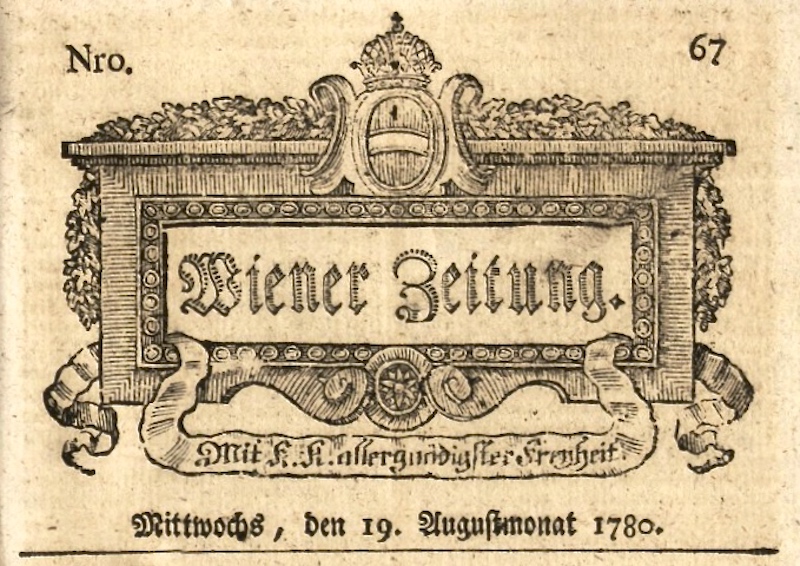
Wiener Zeitung, the world’s oldest national newspaper, has bid farewell to its daily print editions, marking the end of an illustrious 320-year-old tradition.
The historic publication, which began its journey in August 1703, has been a witness to centuries of history, political changes, and cultural milestones. However, a recent law change in Austria has rendered its print format unprofitable, forcing the newspaper to shift its focus to digital distribution.
The crucial alteration came with a new law passed in April by Austria’s coalition government, which removed the legal requirement for companies to publish public announcements in the print edition of Wiener Zeitung.
As a result, the paper lost an estimated €18 million in income, rendering its daily print runs financially unsustainable. The publication’s management had no choice but to make the difficult decision of discontinuing daily print editions.
The impact of this decision has been substantial, as the paper had to cut 63 jobs, including reducing the editorial staff from 55 to 20 members.
The transition to an online-only platform is now underway, and the newspaper is also contemplating a monthly print edition, although details regarding this plan are still being developed.
Wiener Zeitung has a rich history of delivering straightforward and reliable news without any embellishment or poetic language.
Over the centuries, it has covered major events and provided insights into the lives of notable figures. From reporting on a concert featuring the young prodigy Wolfgang Amadeus Mozart in 1768 to publishing the abdication letter of the last Habsburg emperor, Kaiser Karl, after Austria’s defeat in World War I, the newspaper has remained a stalwart source of information for generations.
In its last daily print edition on Friday, Wiener Zeitung took a poignant stance, attributing the end of its print run to the government’s new law.
The editorial emphasized the challenges faced by quality journalism in the modern era, with serious content competing for attention against fake news, cat videos, and conspiracy theories on various digital platforms.
The EU Commission vice-president, Věra Jourová, expressed her concerns over the newspaper’s fate, acknowledging the significant role it has played in informing the public over the years.
Despite the changing landscape of media, Wiener Zeitung has been an essential pillar in Austria’s media landscape.
Throughout its long history, Wiener Zeitung encountered adversity only once when it was forcibly shut down by the Nazis in 1939 during Austria’s incorporation into Hitler’s Germany.
However, in 1945, as Austria emerged from allied occupation, the paper resumed its printing operations, continuing to serve the nation.
The claim to being the world’s oldest newspaper is a subject of contention, with the Gazzetta di Mantova, a local newspaper first published in 1664, and the London Gazette, an official gazette of the UK government dating back to 1665, vying for recognition.
Nonetheless, Wiener Zeitung’s long-standing heritage and contributions to journalism remain undisputed.