

ABU DHABI: Seeing a shooting star may be a miraculous sight to behold, but to be part of something big – a black hole project in space, for instance – beats all.
“It’s mind blowing,” said Alejandro Palado, a respiratory care practitioner whose love for astronomy got him on board, along with a fellow Filipino, in what has become an undertaking spearheaded by the National Aeronautics and Space Administration (NASA) involving what could yet be a black hole in progress.
“I couldn’t believe we could be part of it; we did not lose time to get the coordinates,” he added, noting that fateful day several weeks back when they received word from NASA about the existence of a neutron star, which was also confirmed by New York University – Abu Dhabi.

A neutron star is a celestial object of a very small radius (typically 30 km) composed predominantly of closely packed neutrons. Scientists believe neutron stars are created by the gravitational collapse of the remnant of a massive star after a supernova explosion, provided that the star is insufficiently massive to produce a black hole.
To confirm that the neutron star, named “Maxi J1820+070,” is indeed a black hole candidate, NASA and NYUAD needed somebody who’d keep an eye on it. And that’s where Palado, and their resident astronomer Aldrin Gabuya came in.
“Me and Aldrin were working that day and when we saw the target, it’s heaven to me. We sent data many times, but the coordinates were off initially, until finally a confirmation came that we got the right one,” Palado said.

A black hole is a part or area in space that has so strong a gravitational pull that it can easily ”gobble” anything within its reach.
What’s particularly interesting with “Maxi J1820+070” is its distance to earth.
“The black hole we are monitoring is the closest among all the black holes that have been discovered,” said Palado. He added, “There is a 90% possibility that the object is a black hole and after five years, we don’t know how it’s going to behave, what is direction it is taking, is it moving toward us or away, and the size of it. We keep monitoring.”
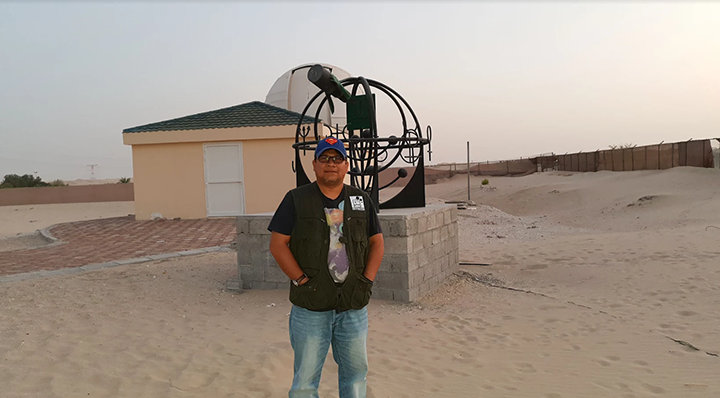
Palado’s and Gabuya’s efforts would not have been possible had it not been to Emirati Astronomer Thabet Al Qaissieh who owns and is co-founder of Al Sadeem Astronomy, the facility from which the two Filipinos are keeping a close watch on “Maxi J1820+070.”

Passion for astronomy
Before Palado got into the observatory, he was a respiratory care practitioner in Abu Dhabi. However, the 48-year-old Ilocano’s passion for astronomy never left him and he was surprised when he learned that there weren’t any astronomy groups, planetariums, or even an observatory in the capital.
“I tried looking for people or group with the same interests but couldn’t find one. In 2007, I started to create a blog site called Abu Dhabi Astronomy with an email attached to it. From there one by one people started following me, showing their interest in the field,” explained Palado.

From then Palado and his peers, the Abu Dhabi Astronomy Group began to receive invites to events such as the Abu Dhabi Science Festival, the Mother of the Nation Festival, and on one fateful day, he received a curious invitation.
“One day I received an email from an Emirati guy asking me to assess his family farm and tell which telescope was perfect to install. When I saw the place, I did not suggest a telescope but an observatory instead. From there the Al Sadeem Astronomy Observatory was created,” said Palado.
When asked if the black hole is an immediate threat, Palado said that the “black hole candidate” may seem near when viewed through the telescope but it’s actually thousands of light years away.
“However, he stressed that it is still important to note the activity of the black hole since the information would be beneficial for future use. “We at Al Sadeem Observatory will continue to monitor the activity as we work together with reputable institutions like the New York University in Abu Dhabi,” Palado said.

Those who are interested to take a view of the stars may book their visit the Al Sadeem Observatory located at Al Wathba south, Abu Dhabi near International Endurance Village and the Camel Race Tracks. http://alsadeemastronomy.ae
Global link
Al Qaissieh, Palado and Gabuya are part of a global network of scientists monitoring “Maxi J1820+070.” Among them Prof. David M. Russel and M. Cristina Baglio of NYUAD; as well as Joe Bright and Rob Fender of Oxford University.
There are also people involved from Chalmers Universty of Technology in Sweden; Paris Diderot University, University of Michigan; University of Southampton; University of Amsterdam; University of Alberta; and Finnish Centre for Astronomy at University of Turku, among others.
What makes Astronomy interesting to learn?
1. You can see planets right before your eyes.
2. Aside from the stars, you will also get to witness the beauty of the evening skies, the stunning nebulae, star clusters, and galaxies.
3. If you’re already interested in watching a meteor shower, viewing it from an observatory with our giant telescope will let you see the fireballs coming from the mother comet or asteroids.
4. From imaging to analyzing stars, nebulae, galaxies and other deep sky objects, we actually experience ‘time travel’. In a sense that, the object or the light you are looking at that moment was a picture of the object ten thousand to millions of years ago. Isn’t it amazing (e.g M101 spiral galaxy, 20.8 million light years away – meaning that time we took a picture of it was an actual picture of the galaxy 20.8 years ago)