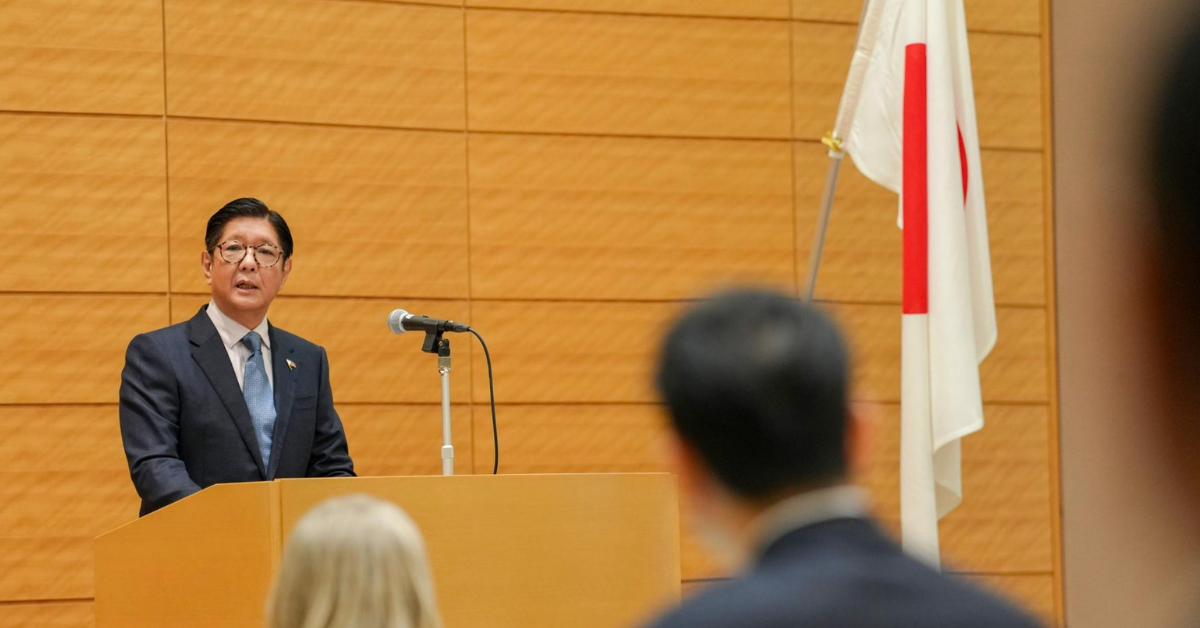
President Ferdinand Marcos Jr. said the Philippines and Japan are poised to elevate bilateral relations to the “highest tier” of diplomatic engagement as both countries move toward establishing a Comprehensive Strategic Partnership.
Speaking before members of the Japan-Philippines Parliamentary Friendship League (JPPFL) in Tokyo, Marcos said the planned partnership reflects the “exceptional level of trust” between Manila and Tokyo amid evolving geopolitical and economic challenges.
“For the Philippines, and I believe for Japan as well, this moment calls not for retreat nor hesitation, but for deeper engagement with one another and with like-minded partners around the world,” Marcos said.
“It is in this context that the Philippines and Japan are moving to elevate our relations to a Comprehensive Strategic Partnership, the highest tier in our diplomatic framework, and a first for the Philippines,” he added.
Marcos said the move underscores the shared commitment of both nations to deepen cooperation in addressing regional and global concerns.
The President noted that the Philippines and Japan are commemorating the 70th anniversary of the normalization of diplomatic relations this year, describing the milestone as a symbol of “reconciliation, trust, and shared purpose” built over seven decades.
He also acknowledged Japan’s longstanding support for the Philippines, saying “no other country has matched Japan in the scale and quality of its development assistance,” particularly in advancing human security initiatives, including projects in Mindanao.
Marcos emphasized the importance of expanding cooperation in economic and maritime security, defense, trade, and investment. He added that Manila is looking to strengthen collaboration with Tokyo in emerging sectors such as clean energy, digital transformation, critical minerals, artificial intelligence, and space cooperation.
“As we navigate shifting currents, the friendship between the Philippines and Japan continues to evolve and to grow stronger,” Marcos said.
The President said both countries would continue to strengthen economic ties through the bilateral Economic Partnership Agreement, which marks its 20th anniversary in September, as well as the Philippines’ prospective accession to the Comprehensive and Progressive Agreement for Trans-Pacific Partnership.
Marcos also recognized the role of the JPPFL in advancing bilateral relations and thanked Japanese lawmakers for their “steadfast support” for the Philippines.
“In this journey, the JPPFL has played a vital role. As parliamentarians, you help ensure that our democratic values are translated into laws and policies that serve our peoples and the broader region,” he said.
The President likewise welcomed Japan’s “more proactive” role in promoting peace, stability, and prosperity in the Indo-Pacific region.
He reaffirmed the importance of ASEAN centrality and unity in shaping “a regional architecture that is open, inclusive, and rules-based.”
“We are most appreciative and encouraged by Japan’s active participation in deepening regional cooperation, particularly through its Dialogue Partnership with ASEAN,” said Marcos, who serves as this year’s ASEAN chair.
Marcos stressed the need for stronger partnerships amid geopolitical tensions, supply chain disruptions, and challenges to the rules-based international order.
“Japan’s contributions to regional security strengthen our collective peace and resilience across the region,” he said.
“Equally significant are Japan’s initiatives in advancing economic security, especially in strengthening supply chains, promoting technological innovation while ensuring that new advancements are used ethically and responsibly for the good of humanity, and safeguarding critical industries in an interconnected and interdependent global economy,” he added.
On Thursday, Marcos is scheduled to address a joint session of Japan’s National Diet and meet with Prime Minister Sanae Takaichi to discuss ways to further expand bilateral cooperation.