What if the future of Calapan City could be designed not by veteran urban planners or international firms, but by students armed with imagination, local knowledge and a deep desire to improve their community?
For five architecture students from Divine Word College of Calapan, that question became the foundation of an award-winning vision that is now gaining international recognition.
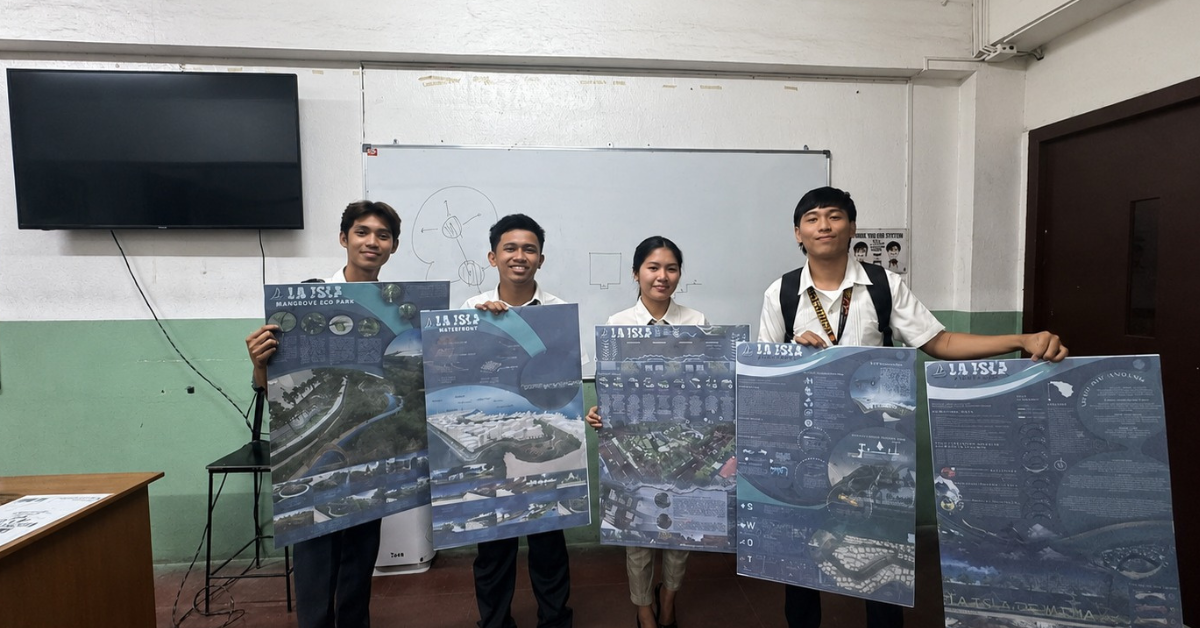
Joemmel Magnaye, Harold De Guia, Harvih Iya Victoriano, Joanne Magnaye and Arth Emmanuelle Guntan never intended to simply create another academic plate. Under the guidance of their Architectural Planning adviser Architect Kirby Mercado, the group developed “La Isla de Mina”, a 25-year urban and tourism masterplan that reimagines Calapan City as a sustainable, people-centered waterfront destination.
Their concept recently won recognition at the TFT Global Student Competition 2026, placing Filipino student talent on the international stage.
Inspired by the movement of sea waves, the proposal transforms the coastal communities into vibrant public spaces that prioritize walkability, tourism, sustainability, and community life. The design includes bike lanes, adaptive public spaces, murals, green corridors, and waterfront developments aimed at making the city more accessible and resilient.
But beyond the modern aesthetics lies a deeper purpose.
The students wanted to address long-standing urban challenges in the area, including congestion, flooding, coastal vulnerability, and the lack of engaging public spaces of Ibaba West and East, commonly referred to as the “Little Tondo” of Calapan.
“Through tactical urbanism, we aimed to transform the area into a vibrant, walkable, and lively environment that encourages tourism, social interaction, safety, and economic growth,” the group said.
Balancing creativity with practicality became one of their biggest challenges. The team had to integrate flood protection and coastal resilience measures without sacrificing the beauty and usability of the waterfront. Their solution combined adaptive coastal defenses with tactical urbanism strategies.
For the students, winning the global competition was more than a personal achievement. It became a reminder that young Filipino designers can contribute meaningful ideas to conversations about architecture, sustainability, and urban development.
“It motives us to continue improving our skills and proves that Filipino students can contribute innovative ideas in architecture, urban planning, and tactical urbanism on an international platform,” they said.
As Calapan City continues to grow, the students behind “La Isla de Mina” hope their ideas will inspire future developments rooted not only in progress, but also in community, identity and sustainability.