
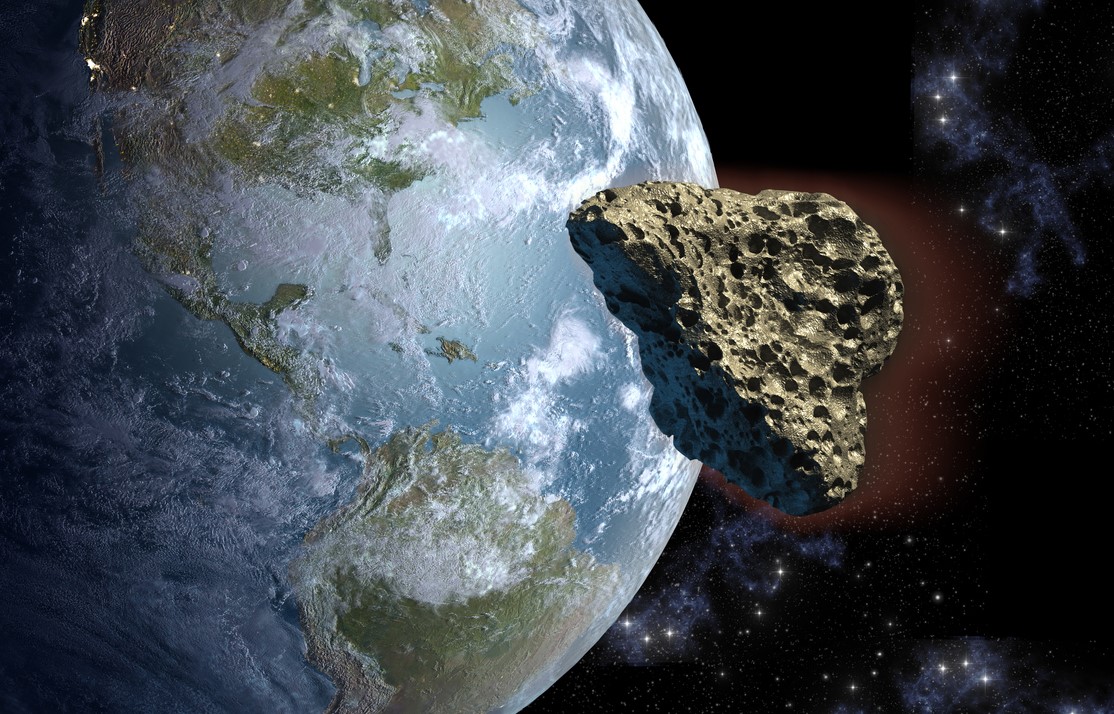
Scientists have shed more light on the 1.2 kilometers wide Trojan asteroid that orbits with the Earth.
Scientists said that the asteroid that was discovered riding along in Earth’s orbit is about 1.2 kilometers wide and might remain as a hitchhiker for at least 4,000 more years while posing no danger.
Using observations from telescopes in Chile, Arizona and the Canary Islands, researchers provided the most comprehensive description yet of the asteroid, named 2020 XL5 and first detected two years ago and confirmed that it is one of only two of what are called Trojan asteroids traveling as a companion with Earth.
RELATED STORY: UAE to explore Venus, seven asteroids in new space mission
Trojan asteroids can be wanderers in the solar system or material left over from their home planet’s formation and orbit the sun along the same path as that of the planet.
Planetary scientist Toni Santana-Ros of the University of Alicante and the University of Barcelona’s Institute of Cosmos Sciences in Spain, lead author of the study published in the journal Nature Communications, said this one look to be a so-called C-type asteroid which is one of the most common kinds in the solar system.
Telescope scientist and study co-author Cesar Briceño of the U.S. National Science Foundation’s NOIRLab said 2020 XL5 poses no threat to earth and “We expect it will remain in its current stable orbit for at least the next 4,000 years.”
READ ON: NASA to launch mission to stop asteroid from hitting the Earth
Its location varies between about 56 million miles (90 million km) and 168 million miles (270 million km) from Earth and the asteroid occupies one of five so-called Lagrange points – positions in space where objects tend to stay put.
2020 XL5, first detected in December 2020 using a telescope in Hawaii, may have been captured by Earth’s gravitational pull somewhere between 500 to 1,000 years ago and numerous Trojan asteroids populate our solar system, with the largest planet Jupiter known to have almost 10,000 of them.
NASA launched a spacecraft called Lucy last October to explore them while Trojan asteroids have also been found around Neptune (28 of them), Mars (4), Uranus (2) and Venus (1).