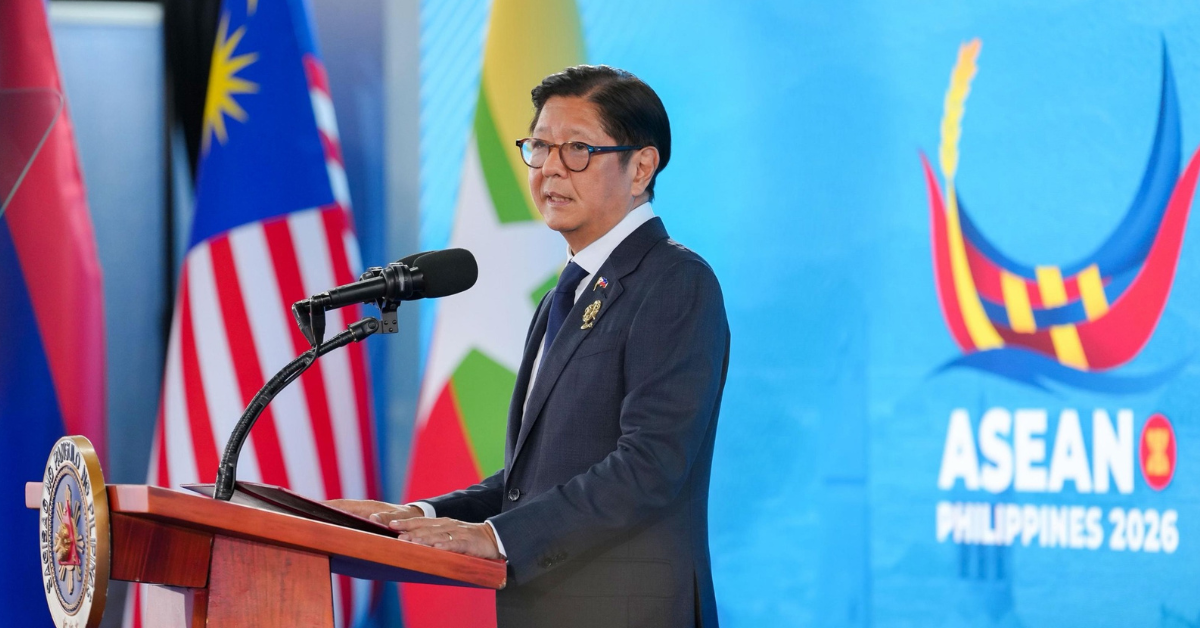
President Ferdinand Marcos Jr. that the Association of Southeast Asian Nations (ASEAN) remains committed to ensuring freedom of navigation in the South China Sea, amid ongoing tensions in the strategic waterway.
Marcos made the statement as Southeast Asian leaders adopted a Maritime Cooperation Agreement, which includes a proposal to establish an ASEAN Maritime Center in the Philippines.
Speaking to reporters on the sidelines of the summit, Marcos said the proposed center would serve as a regional hub for maritime coordination and policy development among ASEAN members.
“As the situation in the South China Sea becomes more, shall we say, unreadable, this becomes more important that there will be a central repository for maritime issues and maritime policy that will apply to ASEAN members,” he said.
Marcos, however, clarified that the initiative is not directed against any country.
“What we are looking for… is not to confront or not to somehow push back on any single force or any single country,” he said.
“It has to be seen from this perspective. What is important is the continued freedom of navigation and the peaceful navigation in the South China Sea,” he added.
The President, who chairs ASEAN this year, stressed that the South China Sea remains a critical global trade route, warning that any disruption could have far-reaching economic consequences.
“A large percentage of world trade goes through the South China Sea,” Marcos said, comparing it to the impact of disruptions in other strategic waterways.
Over the years, tensions in the South China Sea have persisted due to competing territorial claims and reported incidents involving vessels in disputed areas.
Marcos said the proposed maritime center would help strengthen coordination among ASEAN states in monitoring maritime activity, including illegal fishing, smuggling, and human trafficking.
“It is about maintaining safety in the South China Sea, maintaining freedom of navigation, maintaining order… and monitoring maritime activities so there are no gaps and no duplication of work,” he said.
He added that the Philippines has offered to host the facility, which would also consolidate existing monitoring efforts by regional countries.
While expressing optimism over the proposal, Marcos said key details such as funding, structure, and operational framework are still being discussed.
“The job before us is to put together the framework… who will be involved, who will fund it, where will it be, what is it supposed to do,” he said, noting that the concept remains in its early stages.
Marcos said ASEAN leaders showed broad consensus on the initiative, though no timeline has been set for the establishment of the maritime center.