For many Filipinos, commuting remains a daily struggle marked by long queues, unpredictable arrivals, overcrowded vehicles and cash-only transactions.
Despite ongoing modernization efforts, much of the country’s public transportation system still lacks real-time monitoring, efficient passenger management and transparent fare collection.
These everyday frustrations became the driving force behind an award-winning engineering project developed by students from the University of San Carlos.
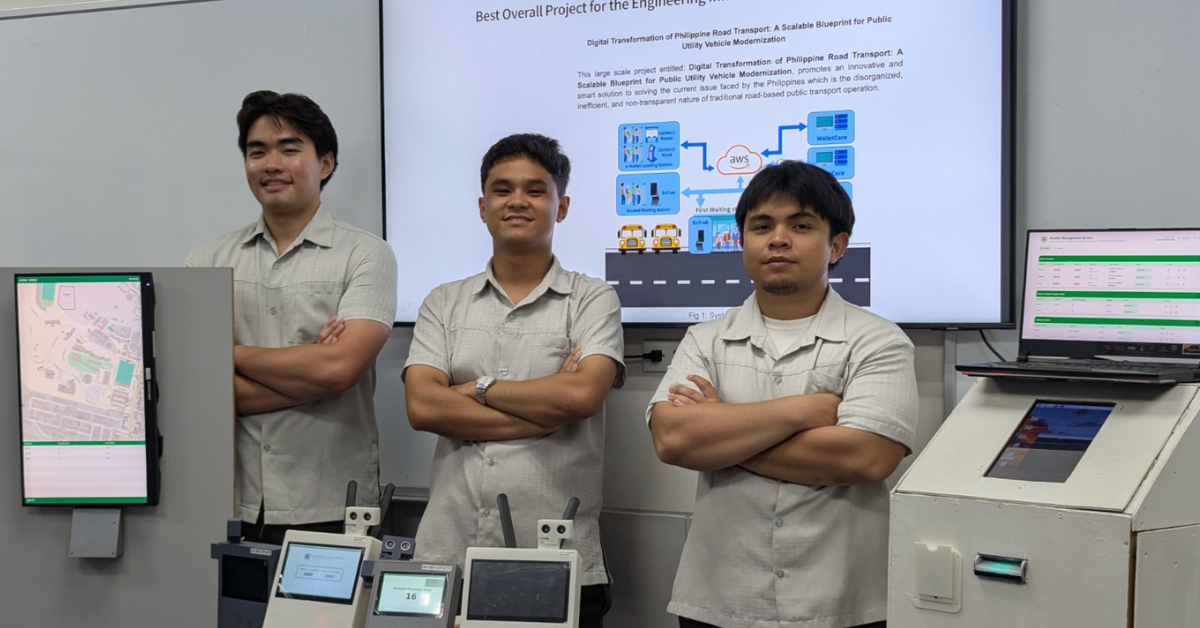
At the TFT Global Student Competitions 2026, a 21-year-old Computer Engineering student Albert Novell Enabe and his team, Jaime Manolo Cortes and Clark Daniel Villacampa, presented a technology-driven transport system designed to modernize public utility vehicle operations in the Philippines.
The project “Digital Transformation of Philippine Road Transport: A Scalable Blueprint for Public Utility Vehicle Modernization,” proposes a fully integrated digital system that combines real-time vehicle tracking, passenger monitoring, and cashless payment systems.
“As students relying on shuttles to navigate the city, the daily queues, cash-handling hassles, and inefficiencies were right in front of us. We realized this was more than just a university-level problem; it reflects a long-standing national challenge,” Enabe said.
To address these concerns, the team developed a smart transport framework powered by IoT technology, cloud computing and digital financial systems.
The system uses a dual-server architecture hosted on Amazon Web Services infrastructure. One server, NaviCore, manages navigation and vehicle terminal connections, while WalletCore processes digital transactions and account management.
Several hardware components were also developed to support the system’s operations.
The “QBoard” device functions as the communication hub inside vehicles, equipped with GPS tracking and 4G connectivity to transmit real-time location data. Another device called “Eplete” monitors passenger entry and exit through RFID technology, while “EvTrak” serves as a live information board at waiting stations, displaying shuttle locations for commuters.
The system also integrates digital payment platforms such as GCash, Maya, and QRPh, allowing users to load transport credits through dedicated e-wallet stations.
According to Enabe, the project was designed as more than a student thesis. He said the system could serve as a scalable model for broader transport modernization efforts across the country.
“Ultimately, this provides a scalable model for a sustainable and digitally transformed transport future across the country,” he added.
Developing the system, however, came with significant technical challenges.
The team had to synchronize six major components while ensuring stable communication between hardware devices, cloud servers, RFID systems, and digital payment channels.
Despite the difficulties, the project’s recognition on the global stage affirmed the team’s belief that Filipino engineers can contribute innovative solutions to national problems.
“It’s an absolute honor to represent the University of San Carlos and show the world that the next generation of Filipino engineers is ready to tackle nationwide challenges head-on,” Enabe said.
As the country continues to seek long-term solutions to transportation inefficiencies, projects like the one developed by Enabe and his team highlight how local innovation and engineering can help shape the future of Philippine public transport.