
The Roads and Transport Authority (RTA) has awarded a major infrastructure contract to upgrade key road corridors across the emirate, aiming to ease traffic congestion, reduce travel time, and support rapid urban growth.
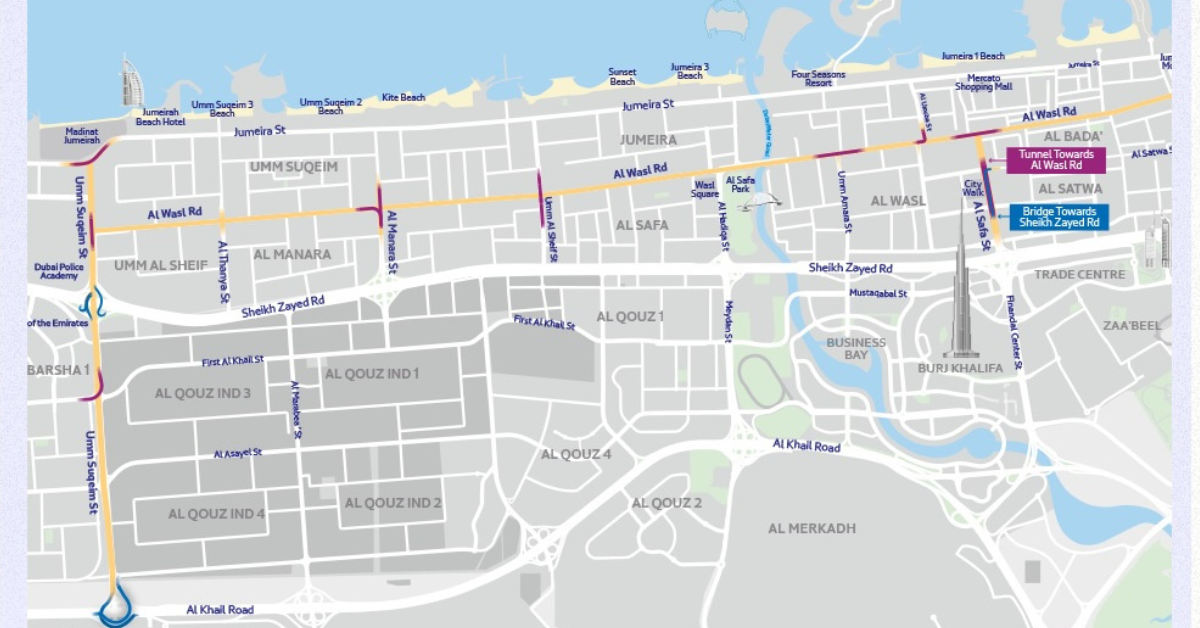
The project will redevelop Umm Suqeim Street, Al Wasl Road, Al Safa Street, and seven intersections along Jumeirah Street. Plans include the construction of 11 kilometers of bridges and tunnels, alongside road widening and intersection improvements.
The initiative forms part of Dubai’s broader strategy to expand road capacity, improve traffic flow, and enhance the quality of life for residents and visitors amid continued population growth.
Once completed, road capacity is expected to significantly increase, with Umm Suqeim Street accommodating up to 16,000 vehicles per hour in both directions, while Al Wasl and Al Safa Streets will handle up to 12,000 vehicles per hour.
The project will also introduce pedestrian-friendly features such as walkways, cycling tracks, boulevard plazas, and landscaped urban spaces to create more accessible and vibrant communities.
RTA Director General Mattar Al Tayer said the development is part of an integrated plan covering key districts including Jumeirah, Umm Suqeim, Al Wasl, and Al Safa, areas that serve more than two million residents and host major residential, tourism, and commercial hubs.
He emphasized that infrastructure development remains a key driver of economic growth, improving mobility, reducing travel time, and enhancing overall productivity.
A major component of the project focuses on Umm Suqeim Street, which links Jumeirah Street to Emirates Road and Al Qudra Street. The upgrade will improve connectivity to major highways such as Sheikh Zayed Road, Al Khail Road, Sheikh Mohamed bin Zayed Road, and Emirates Road.
Travel time between Jumeirah Street and Al Khail Road is expected to drop from 20 minutes to just six minutes.
The Umm Suqeim segment includes six upgraded intersections, four bridges, and two tunnels spanning 4.1 kilometers, with road expansion to five lanes in each direction in key sections.
Meanwhile, Al Wasl Road will undergo a 15-kilometer transformation, including lane expansion and the upgrade of seven intersections supported by five tunnels.
Travel time along the road is expected to be cut by half, while capacity will increase from 8,000 to 12,000 vehicles per hour.
Al Safa Street will also see major upgrades across a 1.5-kilometer stretch, including two bridges and two tunnels extending 3.12 kilometers.
Travel time is projected to drop from 12 minutes to just three minutes, with capacity doubling to 12,000 vehicles per hour.
In addition, seven intersections along Jumeirah Street will be upgraded to ease congestion and improve traffic flow.
Authorities said the project is part of a comprehensive plan to modernize Dubai’s road network, enhance daily mobility, and reinforce the emirate’s position as a global leader in infrastructure development.